I Was a Fashion Outsider. Then I Saw What the Industry Was Hiding
My journey from the newsroom to the front row, and the uncomfortable truths about an industry built on manufactured desire.

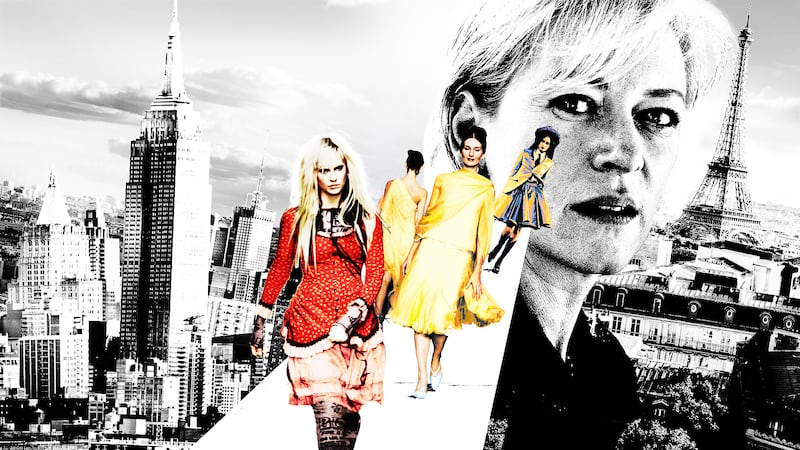
Photo Illustration by Victoria Sunday/The Daily Beast/Getty Images
Politics as theatre. Celebrity as currency. Wellness as religion. And power as the only real language in the room. Subscribe to PRIMAL SCREAM with Joanna Coles on Substack for exclusive news, reviews and commentary.
This week, my inbox was brimming with fashion questions—but they weren’t about what to wear.
After my interview on the Daily Beast Podcast with Carré Otis and Stacey Williams—two women who spoke with bracing clarity about abuse in the modeling industry and their efforts to clean it up for future generations—I received hundreds of messages. Some demanding, some grateful, many asking the same question: When you were at the helm of global fashion magazines, what did you see? Did you know how bad the modeling industry could be?
What did I see when I was editor-in-chief of Marie Claire and Cosmopolitan, two global fashion magazines, approving and overseeing the commissioning of cover shoots, filling the pages with fantasy?

Well, let me step back a moment. The truth is, I stumbled into the fashion world the way one stumbles into a very exclusive party, slightly underdressed and with no idea who anyone was—but happy to be invited.
Get a First Look
Sign up to receive news and updates from The Looker
By clicking "Sign Up" you agree to our Terms of Use and Privacy Policy.
At the time, I was the New York bureau chief for The Times of London. The paper’s editor back in the U.K. called with a problem: New York Fashion Week had collided with Yom Kippur and the fashion editor was unable to attend the shows. Could I go instead?
So, with little notice, I turned up at the huge white tent in Bryant Park that was then hosting NYFW and settled into my front-row seat with zero expectations. And down the runway came the girls: thin, shockingly thin, pale white, and wasted-looking, with that peculiar, almost studied vacancy in their eyes. I remember noticing the fine down on some of their arms, something I hadn’t seen before, and would later learn to recognize as a telltale sign of bodies pushed too far.
Like any good journalist, I wrote what I saw.

Models leave the runway after walking in a New York Fashion Week show on September 17, 2002 in New York City.
Jeff Christensen/REUTERS
Not in the language of fashion—which I didn’t yet speak—but in the language of a normal human being. The girls were too thin. The clothes were often absurd. The program notes, left reverently on every seat to explain the designer’s “inspiration,” read like parodies. And the crowd, oh, the crowd! They seemed dressed not for life but for each other, and very much for attention.
How little I understood.
My pieces ran. Readers responded positively. And so in my self-selected uniform of navy shirt and navy Joseph pants, I was promptly dispatched to cover the icing on the gâteaux of that season’s runways, Paris Fashion Week.
If New York was strange, Paris was operatic.
At one early show by the designer Jean-Charles de Castelbajac, models rose through the floor in clouds of red smoke dressed as French cartoon figures, surreal, theatrical, faintly unhinged. At another, a young designer fresh out of school, Olivier Theyskens, sent models teetering down a runway made of gold-sprayed oyster shells in enormous ballgowns, as if Cinderella had wandered into an avant-garde Red Lobster.

These European clothes were even more extreme. The girls, if anything, were even thinner. The staging was very MDMA. And still, stubbornly literal, I kept writing what I saw.
The reaction was swift and indignant. My reports were splashed across the front page of The Times, framed, correctly, in retrospect, as an attack on the fashion industry itself. Christian Lacroix sent a four-page handwritten rebuttal so florid it practically twirled off the page. I kept it, of course. The handwriting alone was worth the outrage.
What I didn’t yet grasp was the industry’s central sleight of hand. That would come several years later when, with two small boys at home, I moved from the frenetic pace of news to the more predictable pace of magazines and to the editor-in-chief’s seat at Marie Claire.
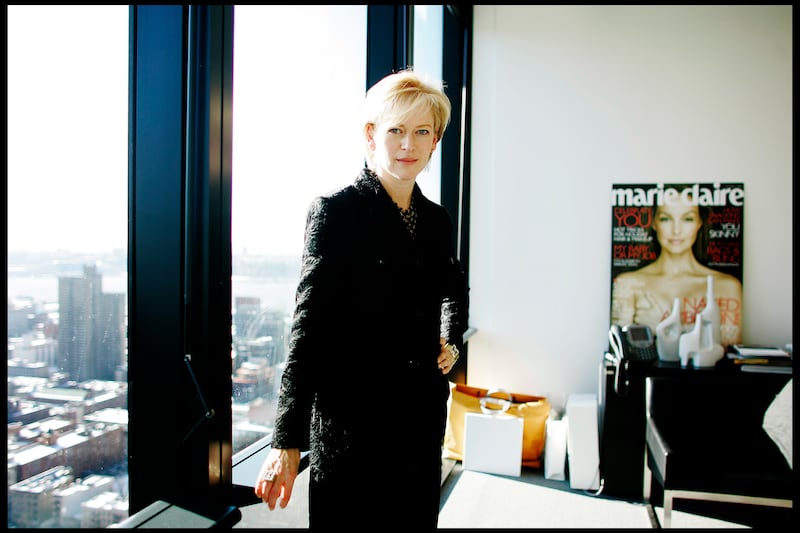
Joanna Coles, the editor of Marie Claire Magazine, photographed in her office. (Photo by David Howells/Corbis via Getty Images)
David Howells/Corbis via Getty Images
It was there I quickly learned that these clothes were not meant to be worn. They were meant to be dreamed about.
The real business was fragrance, handbags, lipstick—the accessible fragments of an inaccessible fantasy. And the models? They weren’t meant to look like women. They were meant to function as something closer to animated coat hangers: blank, boyish, almost pre-sexual forms onto which designers, many of them gay men, could project an idea of femininity unencumbered by the realities of actual female bodies.
And that is where the industry’s darker currents begin to make a kind of terrible sense. If the body is merely a vehicle for a dream, then its needs, its hunger, its health, its safety, become negotiable. If the girl is interchangeable, then her story is, too.
Which brings me back to Carré and Stacey, and to the flood of messages this week. People wanted to know if we were careful. If we knew. If we protected the models.

The answer is: we tried. My teams at both Marie Claire and Cosmo were diligent. I didn’t want anorexic girls to sell clothes to professional women who we were encouraging to lean in and ask for raises. We booked through agencies, not back doors. We checked, we asked, we watched. Occasionally, I spotted a telltale sign: A model drinking black coffee with a spoon, pretending it was soup and murmuring that it was “so filling”. Another advising that cotton pads soaked with orange juice were good for losing weight, because they gave you energy and kept you sated.
But the truth—uncomfortable, unavoidable—is that we were operating inside a system whose incentives were never aligned with protection.

A model has her outfit adjusted backstage at Australian Fashion Week in Sydney on May 17, 2016.
Jason Reed/REUTERS
Fashion, at its peak, was a powerful machine for manufacturing desire. But like so many such machines, the human operators let it run and looked the other way—a kind of studied blindness.
Now, that world is fragmenting, disrupted by influencers, reality stars, and a culture that no longer waits for permission to be seen. The old gatekeepers have lost their grip.
At the magazines that I oversaw, we never knowingly used photographers who had… reputational issues. Sometimes a celebrity would demand that we hire a problematic individual for a cover shoot; in those instances, we would often suggest someone else, or simply say they weren’t available. But celebs were different, because they rarely traveled alone; they arrived with an entourage—publicists and drivers and assistants who kept watch.
Those cover shoots were a madness all to themselves. To be continued…
This article was originally published on Substack. Want to read more from Joanna Coles? Subscribe to PRIMAL SCREAM.

Unlock a year of full access to The Looker and The Daily Beast for $35.
AnnualSave 47%
- Discounted annual rate
- Access to all articles (web + app)
- Ad-free exclusive newsletters
- Commenting Access
- Daily crossword
- Sneak peek of launches & events
Monthly
- Access to all articles (web + app)
- Ad-free exclusive newsletters
- Commenting Access
- Daily crossword
- Sneak peek of launches & events
Ad-Free
- Premium ad-free reading
- Access to all articles (web + app)
- Ad-free exclusive newsletters
- Commenting Access
- Daily crossword
- Sneak peek of launches & events
Looks like you already have a subscription!
You're all set!
Thanks for subscribing.
Register below to read this article for free or subscribe to unlock unlimited access to The Looker and The Daily Beast.
AnnualSave 47%
- Discounted annual rate
- Access to all articles (web + app)
- Ad-free exclusive newsletters
- Commenting Access
- Daily crossword
- Sneak peek of launches & events
Monthly
- Access to all articles (web + app)
- Ad-free exclusive newsletters
- Commenting Access
- Daily crossword
- Sneak peek of launches & events
Ad-Free
- Premium ad-free reading
- Access to all articles (web + app)
- Ad-free exclusive newsletters
- Commenting Access
- Daily crossword
- Sneak peek of launches & events
Already have an account? Sign In
Looks like you already have a subscription!
You're all set!
Thanks for subscribing.
Sign in
Login dialog
Loading comments…