Why Everyone Thinks They Can Decode Your Insecurities From Photos
Nothing is “just a photo” anymore.

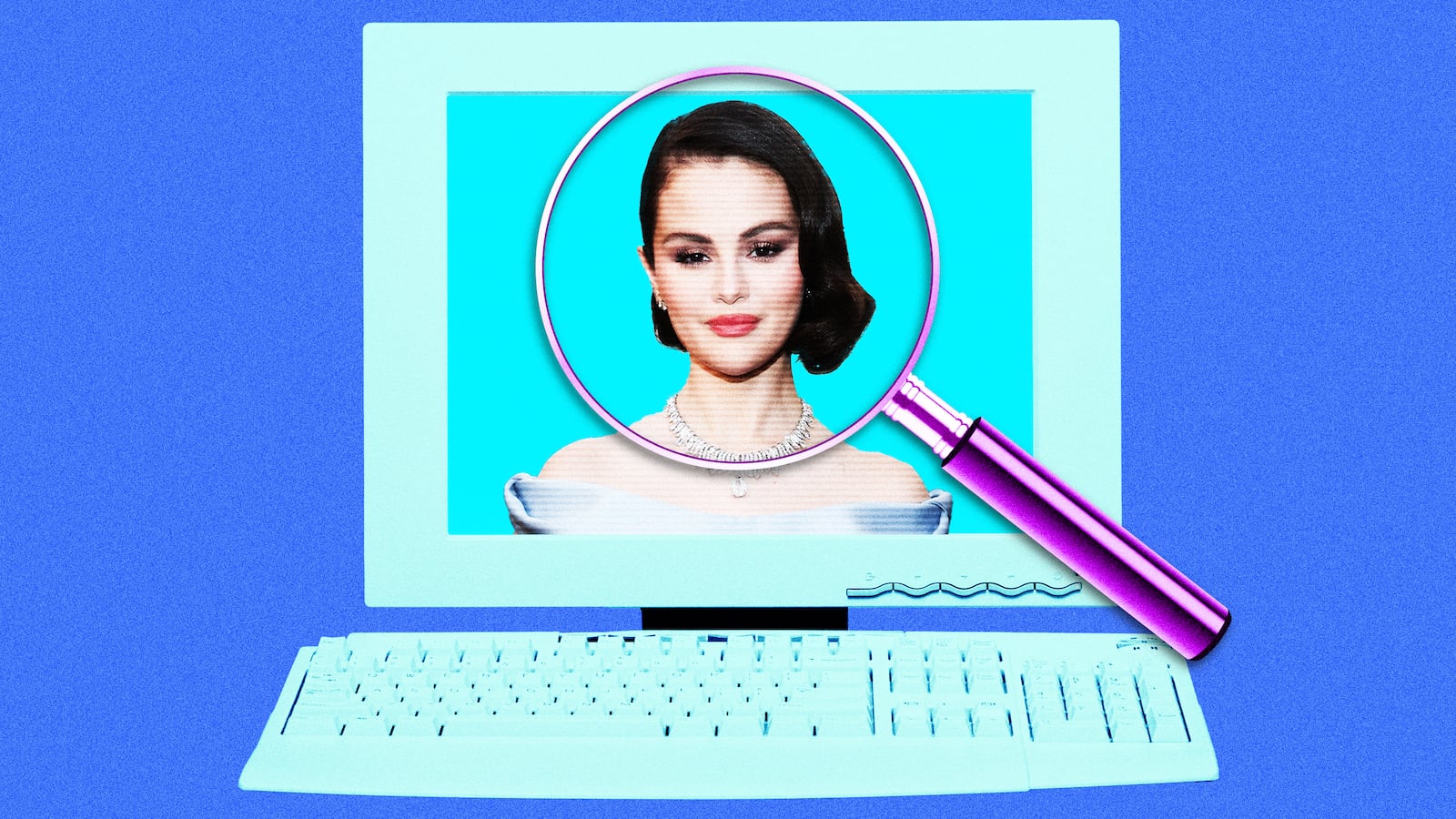
Photo Illustration by Thomas Levinson/The Daily Beast/Getty
There is an ongoing debate about singer and former child star Selena Gomez. People monitor her photos, fixating on any perceived fluctuations in her face and body.
Critics of the A-lister accused her of undergoing cosmetic surgery, insisting that her face and body looked skinnier. Social media users were quick to point out that the starlet suffers from Lupus and that her fuller features could be a side effect of steroids used to treat her autoimmune disease.
Still, the discourse persists—and the damage is done: There are now hundreds, if not thousands, of videos dedicated to guessing Gomez’s face-slimming procedures.
Gomez’s experience highlights a broader trend—one that is no longer reserved for A-listers like her. Across all social media platforms, people now scrutinize posts from anyone in their sphere (friends, family, coworkers), and even those who aren’t (influencers, one-time acquaintances, high school nemeses).
The Surveillance of Selfies
The concept of “reading” other people’s insecurities from their selfies gained momentum last summer.
Get a First Look
Sign up to receive news and updates from The Looker
By clicking "Sign Up" you agree to our Terms of Use and Privacy Policy.
The logic: How you pose, especially in selfies, reveals your biggest hidden bodily insecurity. The angle of your camera, how you distribute your weight through your posture, how you tilt your head—in this environment, nothing is a quirk nor a preference. It is data, and onlookers in person and online will analyze it accordingly.
CandyRetriever /Getty Images
Body language experts have influenced our engagement with politics and pop culture since the early days of mass media. This cottage industry significantly expanded with the rise of social media platforms in the late 2000s and early 2010s.
Turn to the side in a group shot? You must be self-conscious about your weight. Fluffing up your hair in a photo? Clearly, it’s thinning, and you’re terrified that people might find out about it. Do your cheeks appear slightly narrower in a selfie, as Gomez’s did? You obviously underwent buccal fat removal because you despised your face.
Rather than viewing people’s personal updates as casual observers, would-be critics pick apart every pose, angle, and outfit, making conjectures about intent.
We now engage with one another’s digital footprints through an evolution-focused framework, according to Brooke Erin Duffy. “Well, this is what her Instagram picture looked like last year—did she alter her appearance? Did she gain weight?”
Duffy, an associate professor in the Department of Communication at Cornell University, researches the impact of digital social media industries on gender inequality.
She emphasized how much more content ordinary people are sharing of themselves than ever before. With this proliferation of content, we keep tabs on everyone in our feeds, whether we have a relationship with them or not.
Safety in Numbers
Even in the most supportive corners of social media, there is the potential for arguments over perceived insensitivity.
Facebook has become a hub for member-based groups that focus on any appearance-based ailment or anxiety that you can imagine: hair loss, adult acne, psoriasis, and so on.
Andrea Giancontieri is a Gen X advocate for people with lipedema, a lifelong metabolic condition characterized by abnormal fat buildup that is resistant to diet and exercise. She serves as an admin for the Facebook group Lipedema Besties, which has more than 4,500 members of all ages.
“We constantly have people asking how to get surgery paid for,” Giancontieri told the Daily Beast. Over the summer, Giancontieri received millions of views on social media for sharing a video explaining stage 1 lipedema and its easily overlooked symptoms.
Massimo Ravera/Getty Images
Despite the group’s strict behavioral guidelines, including avoiding comments about members’ bodies, comparisons are frequent due to lipedema’s unique four-stage progression.
While lipedema resembles cellulite, it can lead to complete loss of feeling in the legs and immobility if left unmanaged. (Cellulite, meanwhile, is completely harmless.) To conduct self-assessments, patients inevitably compare their symptoms with those of others. These side-by-side posts, while helpful to some, can draw backlashes from other members who find them upsetting.
Beth Thomas, a fellow Gen X member of the group, urged Lipedema Besties members to pause and reflect when feeling triggered by comment sections.
Still, she understands where the objectors are coming from. “It’s a very vulnerable space,” Thomas told the Daily Beast. “We are all dealing with [the same condition] at our own level of consciousness, our own level of stages.”
Glow Up and Blow Away
Across Facebook, Instagram, and TikTok, users are inundated with makeovers, often referred to as “glow-ups.” While there is nothing wrong with self-betterment, the pressure to transform can turn into a source of stress and exhaustion.
“The notion that you can glow up implies a ladder you had to climb to get there, not to mention the possibility of falling off,” Emmeline Clein, the books editor at Cultured and author of Dead Weight: Essays On Hunger And Harm, told the Daily Beast.
In September, beauty influencer Mikayla Nogueira received more than 15.7 million views on her TikTok video addressing criticism that she appeared “different” in person compared with her long-form video content.
“I’m aware that I am not an attractive person,” the beauty mogul told viewers in her famously thick Boston accent. “I’m aware that I am not aesthetically pleasing to look at or photogenic.”
“It’s really easy to take a bad photo of me,” she said through tears. “I don’t have the best side profile, which I’ve talked about and I’ve shown."
Cringe and Bear It
“Tabloid culture has been almost democratized,” beauty writer Jessica DeFino told the Daily Beast. DeFino is the creator and voice behind the widely read Flesh World newsletter on Substack, where she explores topics related to beauty and culture.
“This whole multidimensional person has been flattened down to this two-dimensional image, and I would argue a majority of people’s interactions are happening through [digital] avatars rather than their physical body,” DeFino says.
Getty Images
“Cringe culture has increased with the younger generation (from 'that’s cringe' compilations to trends of kids trying to ‘out-cringe each other‘), and this leads to people naturally deeming more and more things as cringe,” said Shannon McNamara, pop culture commentator and podcaster known as Fluently Forward.
The fear of being labeled cringe-worthy and picked apart can “push people to self-censor in a variety of ways—what they say, post, how they dress.”
The era of the much-maligned BuzzFeed quiz “set into motion a trend to categorize absolutely everything—what type of attachment you are, your zodiac sign,” McNamara said. “It kicked off a wave of trying to categorize and slot everything into boxes.”
Given these shifts in social norms and technology, it is unsurprising that people report feeling simultaneously anxious and disinterested about sharing on social media, knowing that anything they put online is subject to scrutiny.
This form of appearance policing and making assumptions about intent is practically foundational to the conservative manosphere, with male podcasters regurgitating unfounded claims. If, for instance, a girl posts photos of herself in a bikini, it means she is inherently insecure about her body.
DeFino recalled the impact of growing up during the 1990s and early 2000s—the heyday of MySpace, one of the first social media websites, which launched in 2003. She and her friends “became aware of ‘good angles‚’” as their lives were increasingly captured on early digital cameras and shared online.
This [obsession] isn’t just happening with stars on screen and on stage, but with ordinary people.
— Brooke Erin Duffy
“We get these lessons every day that anything you do could be picked up and surveilled and disseminated to millions of people in a really negative way,” DeFino told me.
With these changes in mind, what makes the present day different from, say, the rabid paparazzi culture of the early 2000s or the mean-spirited celebrity blogs of the 2010s?
The change lies in the targets of our speculation and scrutiny, said Duffy, adding, “This isn’t just happening with stars on screen and on stage, but this is happening with ordinary people.”
Similar to most participants in this story, DeFino finds this trend troubling. “The average person has become a media creator. People are stitching TikToks from regular people. It’s not a celebrity whose body we’re critiquing. Regular people are the subjects of media and the makers of media.”
The New Year's Sale is here! $35 unlocks this article and a year of full access to The Looker and The Daily Beast.
AnnualSave 48%
- Discounted annual rate
- Access to all articles (web + app)
- Ad-free exclusive newsletters
- Commenting Access
- Daily crossword
- Sneak peek of launches & events
Monthly
- Access to all articles (web + app)
- Ad-free exclusive newsletters
- Commenting Access
- Daily crossword
- Sneak peek of launches & events
Ad-Free
- Premium ad-free reading
- Access to all articles (web + app)
- Ad-free exclusive newsletters
- Commenting Access
- Daily crossword
- Sneak peek of launches & events
Looks like you already have a subscription!
You're all set!
Thanks for subscribing.
Register below to read this article for free or subscribe to unlock unlimited access to The Looker and The Daily Beast.
AnnualSave 48%
- Discounted annual rate
- Access to all articles (web + app)
- Ad-free exclusive newsletters
- Commenting Access
- Daily crossword
- Sneak peek of launches & events
Monthly
- Access to all articles (web + app)
- Ad-free exclusive newsletters
- Commenting Access
- Daily crossword
- Sneak peek of launches & events
Ad-Free
- Premium ad-free reading
- Access to all articles (web + app)
- Ad-free exclusive newsletters
- Commenting Access
- Daily crossword
- Sneak peek of launches & events
Already have an account? Sign In
Looks like you already have a subscription!
You're all set!
Thanks for subscribing.
Sign in
Login dialog