This Bizarre ‘Syndrome’ Is Causing Distress Among Women
One woman’s viral video sparked debate over a phenomenon called “sad nipples.”

Getty Images
Millions of women are discovering they may share a strange symptom they once assumed was unique: a sudden wave of sadness, dread, or even “impending doom” triggered by something as simple as a nipple brushing against clothing.
The phenomenon, informally dubbed “sad nipple syndrome” online, went viral after one woman described a “feeling of deep and unexplainable overwhelming sadness and guilt” whenever her nipple grazed something.
The video has racked up more than 9 million views, with women flooding the comments in disbelief that others experience the same thing.

One woman's viral video triggered discourse over a phenomenon shared by millions of others.
TikTok
Others dubbed the area the “button of despair,” describing the nauseating sensation as “maybe the worst feeling ever.”
Though the phenomenon is not recognized as a formal medical condition, experts say there may be biological explanations for why some women experience an intense emotional reaction to nipple stimulation.
Get a First Look
Sign up to receive news and updates from The Looker
By clicking "Sign Up" you agree to our Terms of Use and Privacy Policy.
Dr. Susanna Unsworth, an intimate health expert at Intimina, told Tyla that hormonal shifts could play a role.
“Nipple and breast stimulation are known to affect oxytocin levels, so it is biologically plausible that similar mechanisms could contribute to these emotional responses in some non-lactating individuals too,” she said.
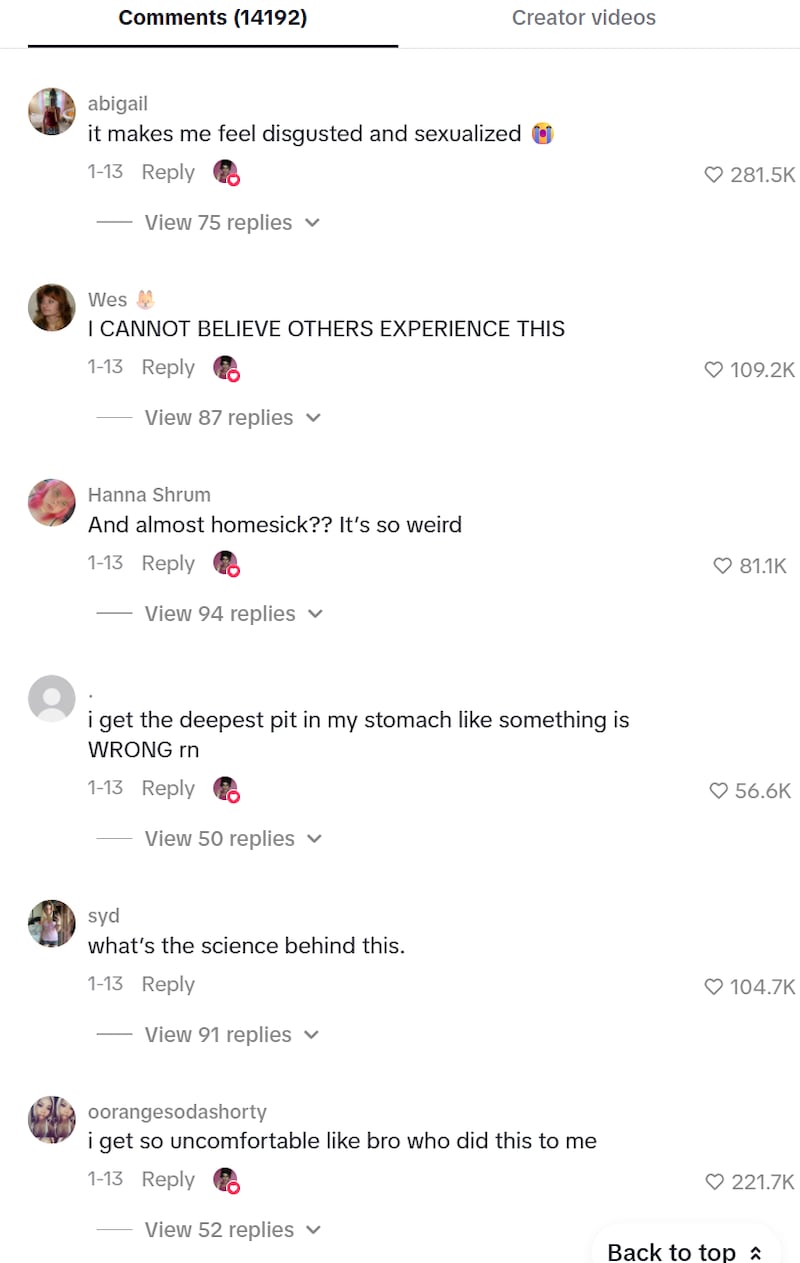
The creator's comments quickly filled with other woman sharing what they believed to be a unique experience.
TikTok
Unsworth pointed to the closest known medical comparison: dysphoric milk ejection reflex, or D-MER, a condition experienced by some breastfeeding mothers that causes sudden feelings of sadness, anxiety, dread, or other negative emotions when milk is released.

Researchers believe D-MER may be linked to a brief drop in dopamine—a neurotransmitter associated with pleasure and reward—that occurs as milk production hormones are activated.
Although several women experiencing the viral phenomenon say they are not breastfeeding, experts say the overlap is worth exploring.

Doctors compared the phenomenon to the breast feeding condition D-MER.
JOY MALONE/REUTERS
A study published in the National Library of Medicine found that nipple stimulation can increase oxytocin levels even in nonlactating women.
That finding has prompted some experts to wonder whether a similar hormonal mechanism could be involved for women suffering from “sad nipples.”
“This raises a biologically plausible—though as yet unstudied—question about whether the same dopamine mechanism may be at play in women who have never breastfed,” OB/GYN Dr. Melissa Walsh told the New York Post.
Many women sharing their experiences online said the feeling began long before pregnancy or breastfeeding entered the picture.

Some commentors without children pushed back on the idea that the phenomenon could be linked to breastfeeding.
Creative Images Lab/Getty Images
“Happened to me since I was a kid, and it was awful once I had a kid,” one commenter wrote in response to suggestions that the phenomenon could be linked exclusively to D-MER.
Dr. Ari Hoschander, a plastic surgeon in New York, told the Post that the reports sound more like physiological responses than psychological ones.

“What [they’re] describing sounds like that dopamine drop hitting particularly hard,” he speculated.
Walsh said recognizing a possible biological explanation can be reassuring for women who experience the phenomenon.

Many women in the comments appeared to agree.
“I didn’t experience [sexual trauma] and I have this feeling. I don’t think it’s a trauma response,” one woman wrote.
Hoschander noted that the nipple-areola complex is among the most neurologically dense areas of the body, meaning stimulation can trigger surprisingly powerful reactions.
The good news, he said, is that the feelings typically pass as quickly as they arrive.

Doctors believe the phenomenon is linked to a physiological condition rather than a psychological.
Pressmaster/Getty Images
While women have found community online around the experience, research into the phenomenon remains limited.
For those struggling with recurring symptoms, Unsworth recommends identifying potential triggers—including certain clothing fabrics—and practicing relaxation techniques. In more severe cases, she said cognitive behavioral therapy may help.
“This is an area that highlights how much more research is needed into women’s hormonal and neurobiological experiences,” Unsworth said.
Unlock a year of full access to The Looker and The Daily Beast for $35.
AnnualSave 47%
- Discounted annual rate
- Access to all articles (web + app)
- Ad-free exclusive newsletters
- Commenting Access
- Daily crossword
- Sneak peek of launches & events
Monthly
- Access to all articles (web + app)
- Ad-free exclusive newsletters
- Commenting Access
- Daily crossword
- Sneak peek of launches & events
Ad-Free
- Premium ad-free reading
- Access to all articles (web + app)
- Ad-free exclusive newsletters
- Commenting Access
- Daily crossword
- Sneak peek of launches & events
Looks like you already have a subscription!
You're all set!
Thanks for subscribing.
Register below to read this article for free or subscribe to unlock unlimited access to The Looker and The Daily Beast.
AnnualSave 47%
- Discounted annual rate
- Access to all articles (web + app)
- Ad-free exclusive newsletters
- Commenting Access
- Daily crossword
- Sneak peek of launches & events
Monthly
- Access to all articles (web + app)
- Ad-free exclusive newsletters
- Commenting Access
- Daily crossword
- Sneak peek of launches & events
Ad-Free
- Premium ad-free reading
- Access to all articles (web + app)
- Ad-free exclusive newsletters
- Commenting Access
- Daily crossword
- Sneak peek of launches & events
Already have an account? Sign In
Looks like you already have a subscription!
You're all set!
Thanks for subscribing.
Sign in
Login dialog
Loading comments…