I Let a Chatbot Dictate My Marathon Training, and It Almost Ruined the Race
Its prep plan got me across the finish line, but fitness experts spotted some major flaws.

Photo Illustration by Elizabeth Brockway/The Daily Beast/Getty
I have never enjoyed running.
Once I finally put down whatever devastatingly tragic, yet steamy fantasy book I’m in the middle of (I read a lot), I’ll always prioritize spending time with loved ones and work over going to the gym.

Still, during my quarter-life crisis, I decided to take on the challenge of a half-marathon. (The end of grad school, a rough break-up, and the general abysmal state of the world may have had something to do with it.) The only path forward, as hellish as it seemed, was a half-marathon, though I had little experience with the core activity one involved. I inevitably gave up each time I attempted to start jogging “for fun,” and got winded in my weekly soccer matches.
I knew enough about marathons to know that I needed to train, and recognized my own limitations enough to know I would need some assistance. But personal trainers were prohibitively expensive—a justifiable cost for their expertise, but not in my budget at the time—so I turned to ChatGPT for help.
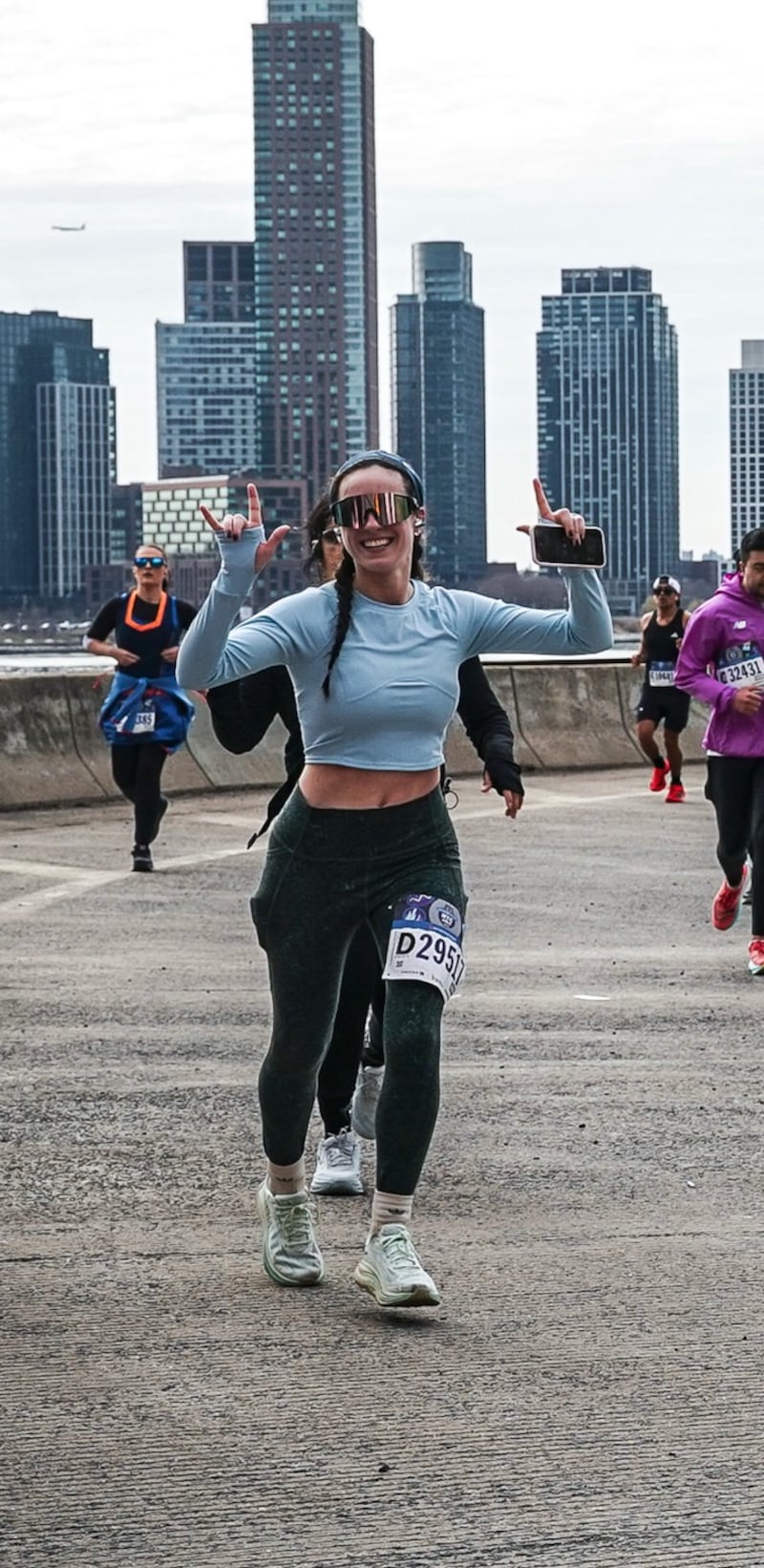
Running my first half-marathon ended up going better than expected.
Courtesy of Georgina DiNardo
A few years earlier, I reported on the Pentagon’s use of artificial intelligence. The biggest takeaway from that experience: don’t put your trust in AI.
Get a First Look
Sign up to receive news and updates from The Looker
By clicking "Sign Up" you agree to our Terms of Use and Privacy Policy.
Still, my familiarity with the subject made me feel comfortable giving it a chance to help with my relatively low-stakes scenario.
I prompted ChatGPT to plan and tailor a workout schedule for me over the course of about 2.5 months to kick my butt into shape.
Kicking Off
I entered my weight, height, and running level (beginner), and asked ChatGPT to formulate a training plan for me.
The plan kicked off with interval training.
Starting in Week 1, I trained in 30-minute sessions, three times a week. During these sessions, I ran for one minute straight, then walked for two minutes. In Week 2, I ran for two minutes, then walked for two. My training plan continued like this, incrementally increasing my running by one minute per week.
At Week 5, approximately the halfway mark to my half-marathon, ChatGPT instructed me to try a “short run” of 2–2.5 miles. I ran about 2.3 miles before calling it quits, but felt exhilarated and thrilled at how much easier it was to run in comparison to the first week.
Two days later, ChatGPT told me to take a “long run” of 3.5 miles.

ChatGPT began my training with interval training.
Courtesy of Georgina DiNardo
For the rest of my training schedule, ChatGPT instructed me to alternate between short runs and long runs, with the length of the runs increasing by 0.5–1 mile per week.
A Uniquely AI Error
The instructions I received from ChatGPT were often helpful (or, at the very least, harmless), with one notable exception.
The day before the half-marathon, a 13.1-mile race, ChatGPT told me to complete a 12-mile run.
This suggestion likely came down to the wording of my initial prompt and is indicative of the inherent limitations of using non-human tools for highly human activities.
I originally asked ChatGPT to prepare me for a half marathon by March 15. I did not specify that the half marathon was on March 15.
“That’s the thing—a real person can ask follow-up questions, as opposed to you filling out a grid of questions, and then it slaps up a program,” fitness trainer Gerren Liles told The Looker.
It was my friends, not ChatGPT, who gave me the best advice. Without them, I wouldn’t have known about high-energy gels, or the water around the race’s route, or several other day-of tidbits. The chatbot might have informed me of these facts if asked, but how would I ever know to ask, given it was my first race?
A real person can ask follow-up questions, as opposed to you filling out a grid of questions, then [the chatbot] slaps up a program.
— Gerren Liles, fitness trainer
ChatGPT also suggested I do “optional training” once a week for something other than running, but didn’t specify what that would be. I played soccer once a week, so I counted that as my optional training, partly because I struggled to wake up early on a Friday to train again, and the word “optional” let me mentally shrug off the recommendation.
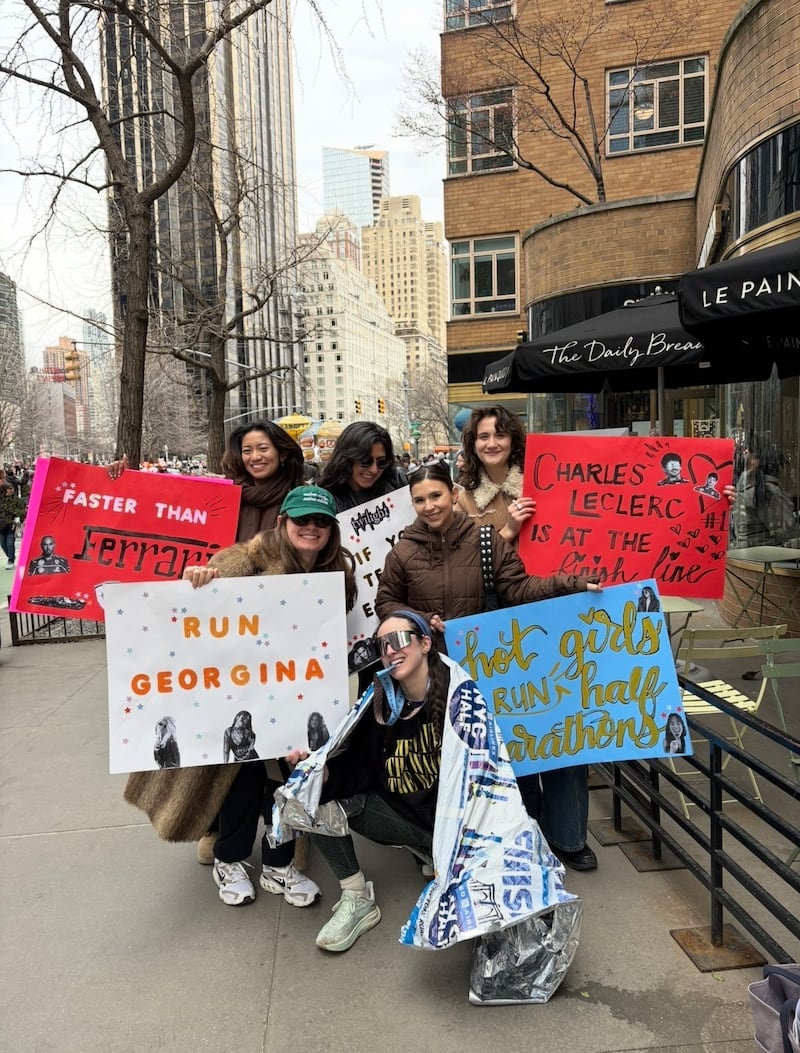
I found it was hard to motivate myself to do ChatGPT's suggestion of "optional training."
Courtesy of Georgina DiNardo
Kate Georgiadis, a strength and conditioning coach and the founder of DDKT Fitness, told The Looker that your “mindset and mentality” need to be trained as well, which the chatbot couldn’t do.
“By adding the word ‘optional,’ there’s no real ‘why’ there. It didn’t solidify why you would want to do that,” Georgiadis said, noting that she would ensure a client understands the purpose of such a task.
She continued, “If you do strength training those days, it would be to prevent injury, but also to actually make you a better runner, because having more muscle mass, stronger muscles, stronger bones, and will build up your capacity for running.”

Liles highlighted that when people work out, there’s often a “social component to it.” He argued that AI can’t replace the social element that trainers provide, including their motivation and human interaction.
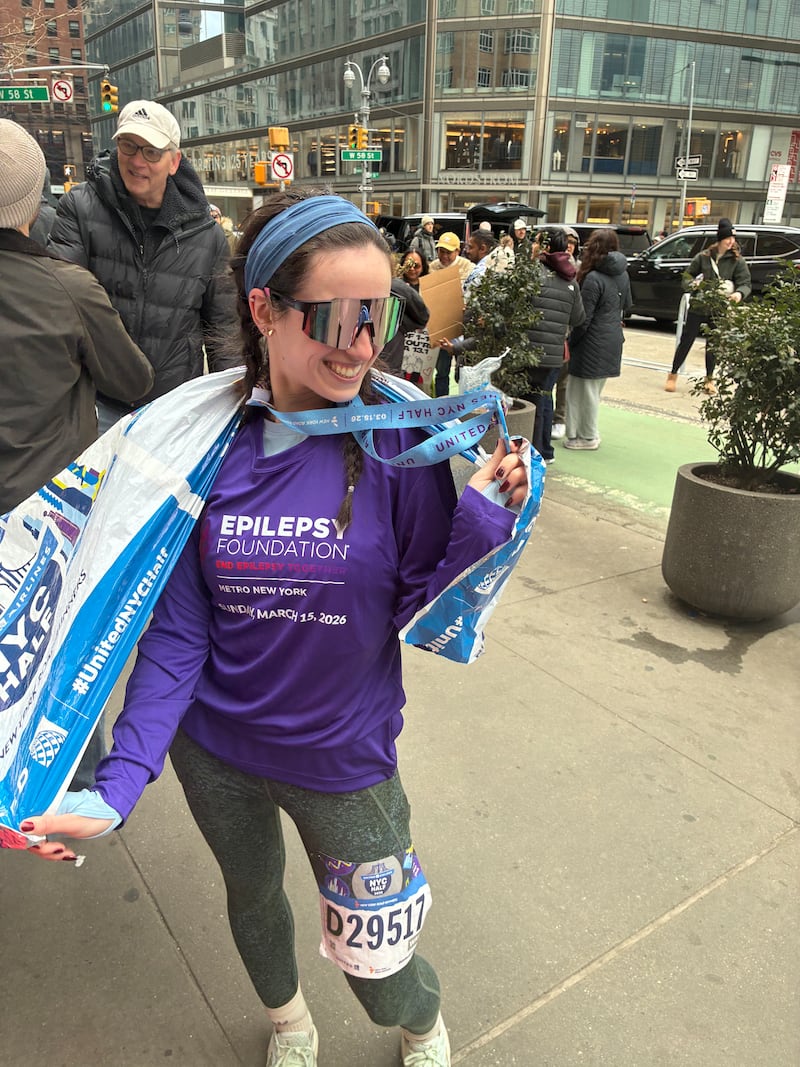
Now, I feel much more confident to run a full marathon next year.
Courtesy of Georgina DiNardo
Without a personal trainer, I struggled to gauge whether missing a day of training due to sickness or the intense snowstorm that hammered New York City would throw off all my work.
By calling it ‘optional training,’ there’s no real ‘why’ there. The chatbot didn’t solidify [the purpose of] that.
— Kate Georgiadis, trainer and founder of DDKT Fitness
Liles said that the “adaptability that comes with having a one-on-one engagement” with a personal trainer can’t be replicated by AI. He added that since ChatGPT’s data is usually aggregated from the general population, it doesn’t account for possible injuries, different body types or specific individual goals.
The Good, the Bad, and the Chatbot
Interval training was a great start for me as someone who wasn’t completely out of shape but wasn’t used to running long distances. Georgiadis explained that interval training is used “to start accumulating steps without having to run continuously.”
“That is a very solid approach for somebody that’s not a runner and wants to start cautiously,” she added. And it was exactly how I needed to begin. But, as Georgiadis points out, everyone’s body is different; she would plan others’ workouts with different starts depending on their age, training level, and time to train.
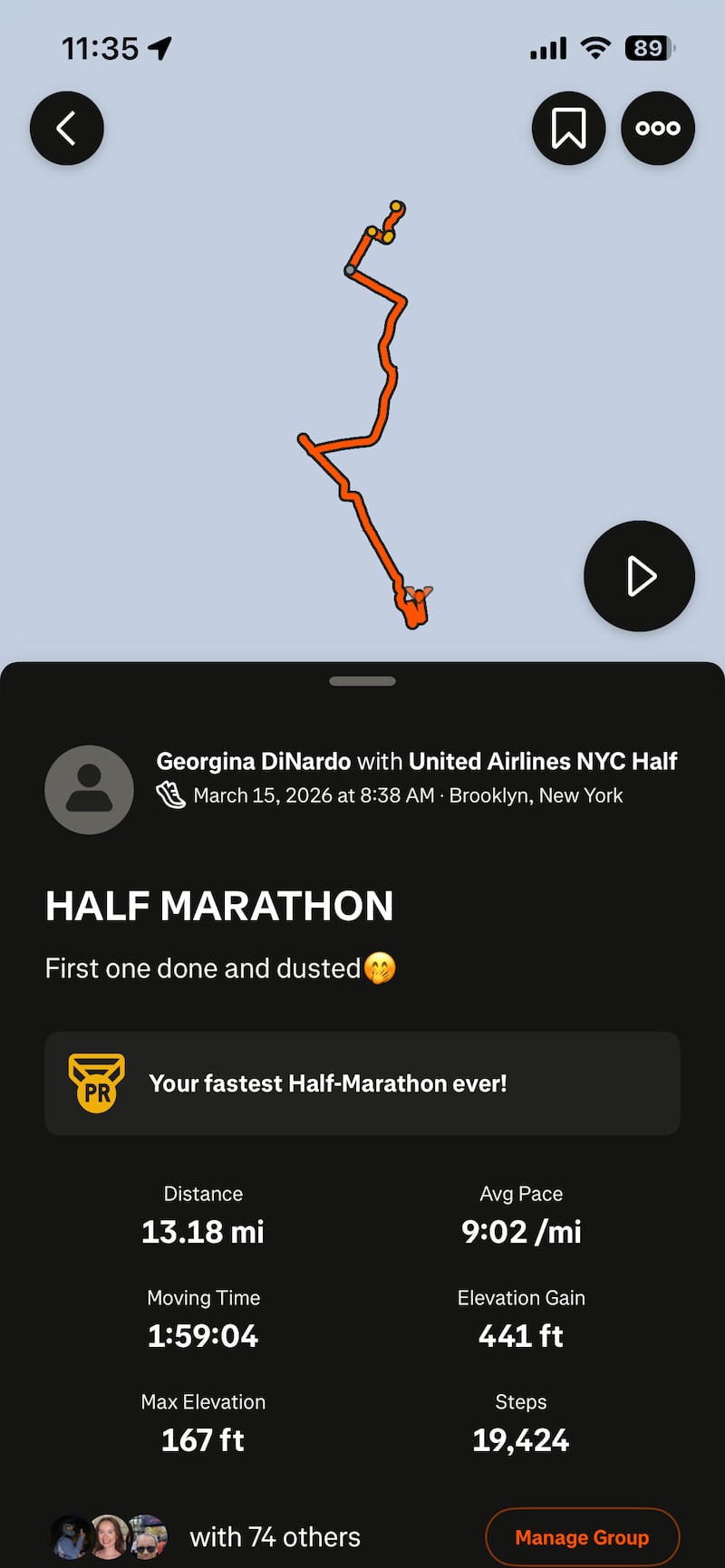
Even though ChatGPT wasn't perfect, I was still able to finish my first half marathon in almost exactly two hours.
Courtesy of Georgina DiNardo
She notes that based on the timeline I gave the chatbot, it began my training appropriately slowly, but felt that ChatGPT jumped me up too quickly once my short and long runs began.
“It almost started perfectly slow if you were to have double the amount of time or triple the amount of time later,” she said.
Georgiadis explained that if she were training me, we would monitor how I was feeling through interval training and either front-load or back-load that to my needs.
But in the end, the chatbot helped me complete my first half marathon in just under two hours, which I wasn’t expecting to make. With this in mind, I was happy with my results, but would be wary in the future of all of ChatGPT’s “ideas.”

Unlock a year of full access to The Looker and The Daily Beast for $35.
AnnualSave 47%
- Discounted annual rate
- Access to all articles (web + app)
- Ad-free exclusive newsletters
- Commenting Access
- Daily crossword
- Sneak peek of launches & events
Monthly
- Access to all articles (web + app)
- Ad-free exclusive newsletters
- Commenting Access
- Daily crossword
- Sneak peek of launches & events
Ad-Free
- Premium ad-free reading
- Access to all articles (web + app)
- Ad-free exclusive newsletters
- Commenting Access
- Daily crossword
- Sneak peek of launches & events
Looks like you already have a subscription!
You're all set!
Thanks for subscribing.
Register below to read this article for free or subscribe to unlock unlimited access to The Looker and The Daily Beast.
AnnualSave 47%
- Discounted annual rate
- Access to all articles (web + app)
- Ad-free exclusive newsletters
- Commenting Access
- Daily crossword
- Sneak peek of launches & events
Monthly
- Access to all articles (web + app)
- Ad-free exclusive newsletters
- Commenting Access
- Daily crossword
- Sneak peek of launches & events
Ad-Free
- Premium ad-free reading
- Access to all articles (web + app)
- Ad-free exclusive newsletters
- Commenting Access
- Daily crossword
- Sneak peek of launches & events
Already have an account? Sign In
Looks like you already have a subscription!
You're all set!
Thanks for subscribing.
Sign in
Login dialog
Loading comments…